SciMDR: Advancing Scientific Multimodal Document Reasoning
300K question–answer pairs with reasoning chains over 20K papers, written for focused passages and then re-embedded in full documents, plus an expert-annotated benchmark.
Published work from our group, ordered along the research loop.
Finding, reading and synthesizing papers.
300K question–answer pairs with reasoning chains over 20K papers, written for focused passages and then re-embedded in full documents, plus an expert-annotated benchmark.
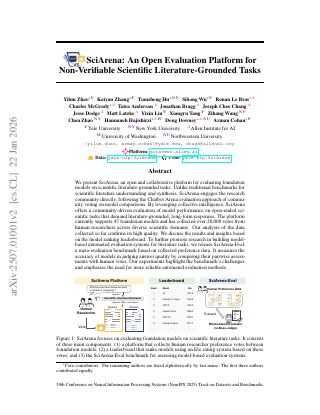
An arena where researchers vote between model answers to literature questions, with over 20,000 votes on 47 models, plus a benchmark for automatic judges.
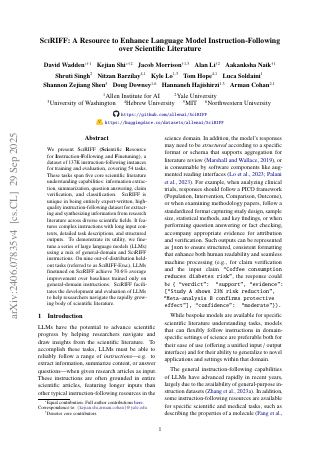
137K expert-written instructions across 54 literature tasks; fine-tuning on them improves held-out scientific tasks by 70.6% on average.
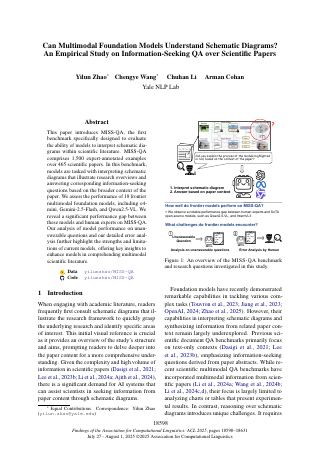
3,000 expert-annotated questions about the schematic diagrams in 983 papers; 18 frontier multimodal models still trail human experts.
Proposing and specifying research ideas.
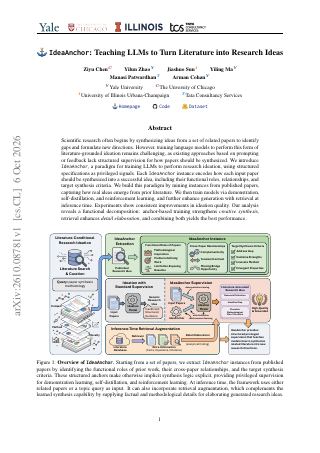
Mines published papers for how their ideas grew out of prior work, and uses that structure to train LLMs to turn a set of papers into a research idea.
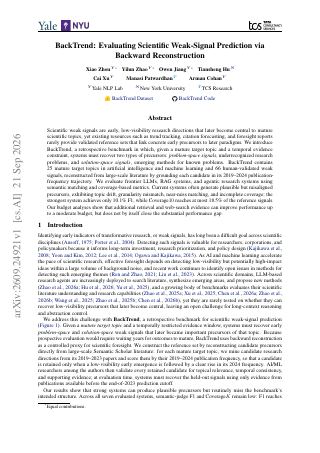
Can systems spot research directions before they become mainstream? 66 validated early signals behind 25 mature AI topics; the best system reaches 10.1% F1.
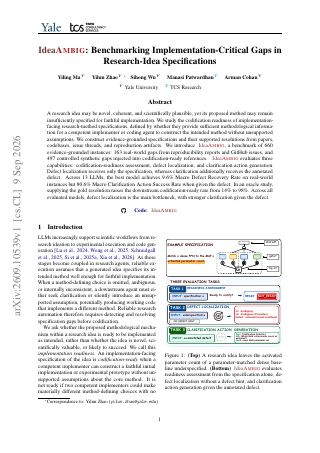
660 method specifications with gaps that block implementation; across 13 LLMs, finding the gap is the bottleneck, with 9.6% recovered on real-world cases.
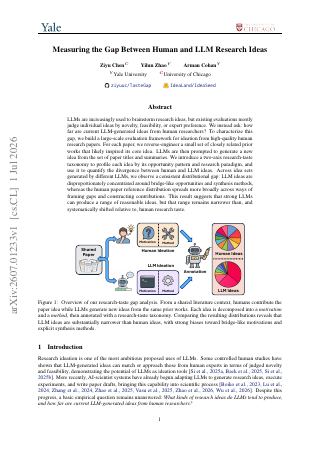
Gives LLMs the prior papers that inspired real research ideas and compares what they propose with what humans did; LLM ideas cover a narrower, shifted range.
Planning studies and designing ablations.
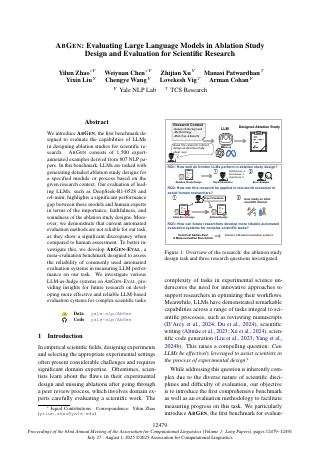
2,000 expert-annotated ablation-study design tasks from 677 NLP papers, plus a meta-benchmark showing that automatic judges are unreliable for this task.
Solving scientific problems with knowledge and reasoning.
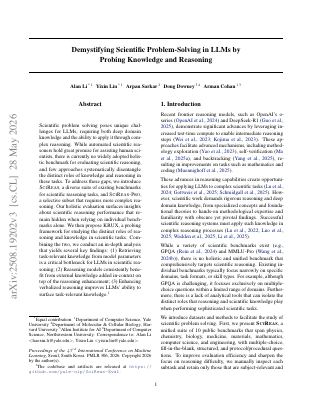
A suite of scientific reasoning benchmarks and a probing framework that separates knowledge from reasoning; recalling the relevant knowledge is a key bottleneck.
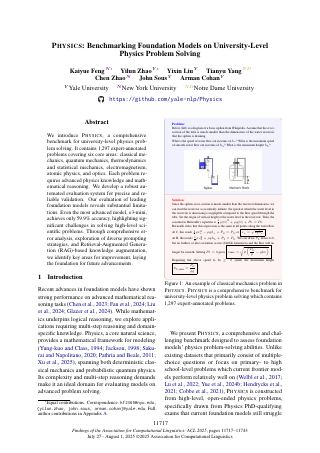
1,297 expert-annotated university physics problems across six areas; the strongest model tested, o3-mini, reaches 59.9%.
Verifying claims, finding limitations, reviewing papers.
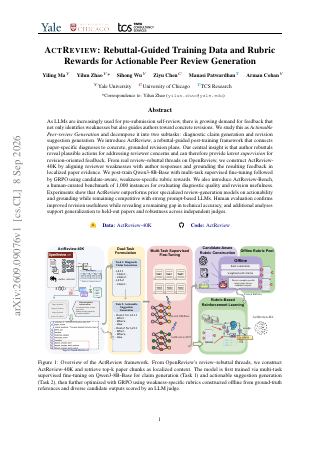
Learns from how authors answered real OpenReview reviews to train a reviewer that suggests concrete revisions, with a 1,000-instance human-curated benchmark.
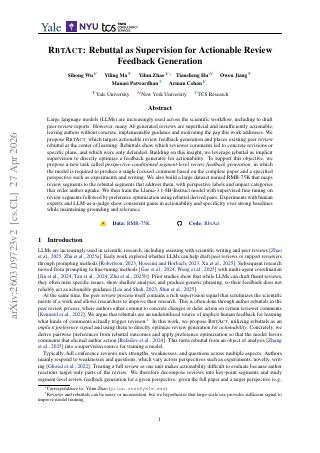
Uses rebuttals to learn which review comments led authors to change their papers, and trains a model to write focused, actionable comments.
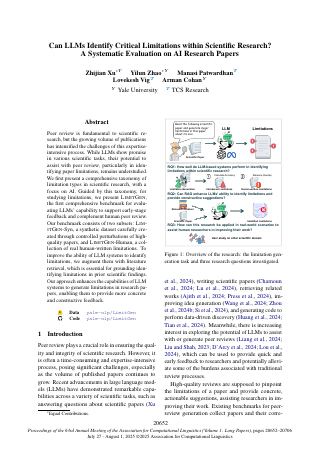
A taxonomy of limitation types and a benchmark of synthetic and real limitations in AI papers; retrieving related literature helps LLMs find them.
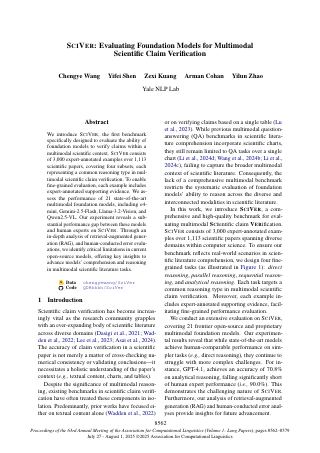
3,000 expert-annotated claims to check against the text, tables and figures of 1,113 papers; 21 multimodal models trail human experts.
Figures and diagrams for scientific papers.
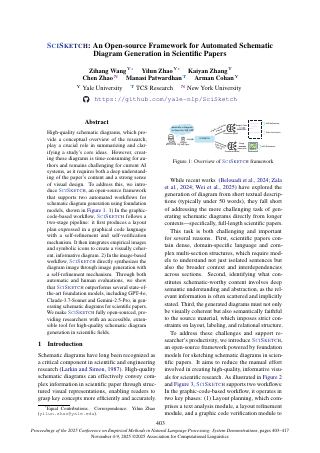
An open-source framework that draws a paper's schematic overview diagram, either by planning a layout in graphics code or by generating the image directly.
How to evaluate LLM-based agents.
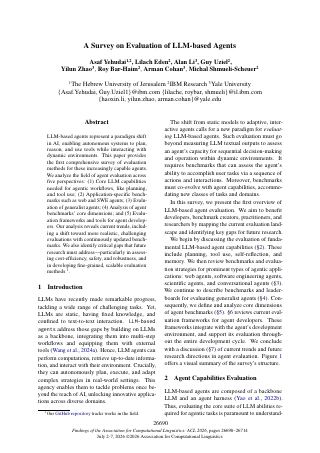
How LLM-based agents are evaluated, from planning and tool use to web and software agents, and where evaluation of cost, safety and robustness falls short.